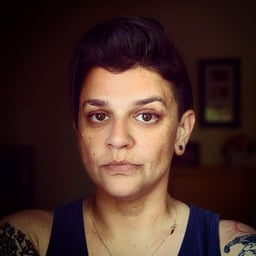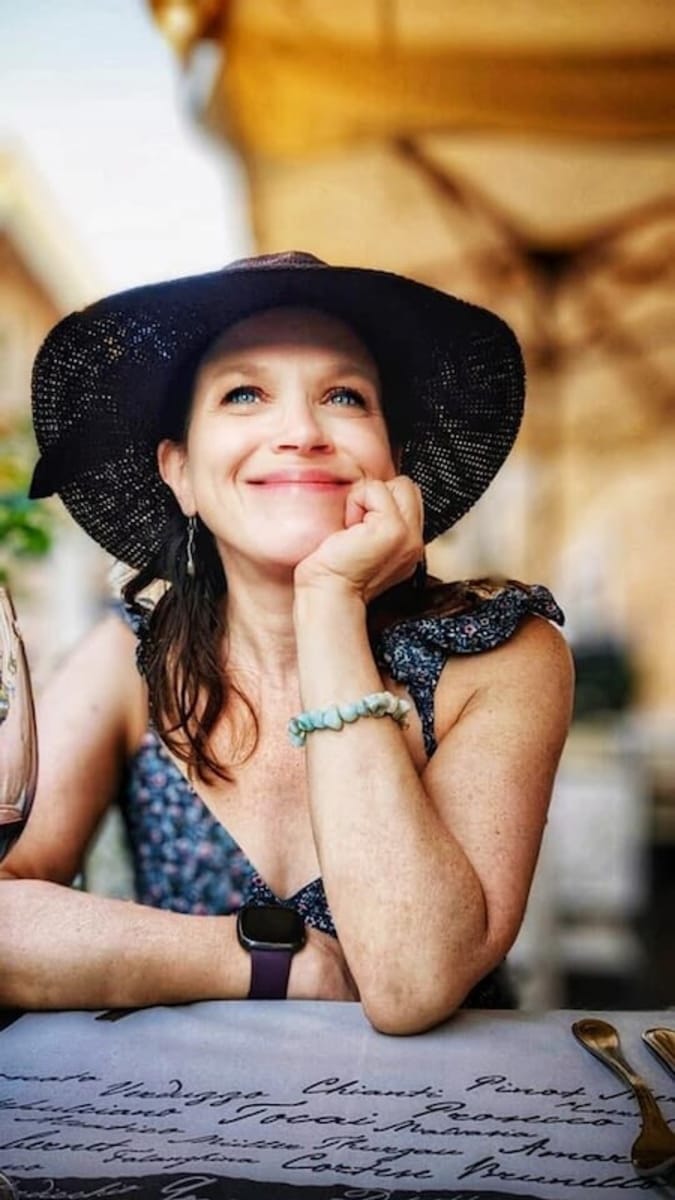

Alicia Escott feels her role is to bear witness to climate change.
“We’re living through the sixth mass extinction. It’s an enormous moment of loss and change, and it’s all around us,” Alicia Escott tells me.
Escott is an interdisciplinary San Francisco artist who approaches the climate crisis as a witness. Through her work, she creates space to sit with the emotional reality of the present: grief, disorientation, loss, and the uneasy persistence of hope.

“Metabolic Rifts” installation on the Great Highway, June 2024
Escott’s work exists where tenderness and heartbreak coexist, inviting viewers to hold grief and care at the same time. It is shaped by the ways we move through our daily lives under the weight of sweeping ecological loss and the social and political volatility that accompanies rapid change, unresolved grief, and a constant undercurrent of anxiety.
Her work spans drawings, paintings, photographs, sculptures, videos, writings, performance, and research-driven experiments. Much of it is built around delicate or impermanent materials that mirror ecological fragility, often juxtaposed with products of modern life, such as electronics and plastic.
“I’ve been working with plastic for around 20 years. It’s kind of my material, and it’s had so many iterations in my work,” Escott says. “Plastic is very bad. It’s been found in placentas, breast milk, lungs, and brains. It’s very frightening. I’m not advocating for it.”
Instead, she uses the material to force confrontation. “I try and reuse the plastic to point to it,” she says, “not pretending it’s not there.”

“Tying Together Pieces of Air Kept Apart: Xerces and Mission Blue,” 2017
In Tying Together Pieces of Air Kept Apart: Xerces and Mission Blue, plastic bags are bound together with wire, their surfaces marked with images of butterflies — the Mission Blue, introduced after the Xerces blue, which once lived among the dunes of the Outer Sunset, was driven to extinction in the 1940s. The Mission Blue lingers uneasily: a stand-in for what has already been lost, and a reminder that replacement is not the same as repair.
Bound and repeated, the materials tell a story of containment, accumulation, and a beauty that refuses to let the damage disappear from view. Like all of Escott’s work, the piece gives us pause, inviting reflection on our own role within the systems it exposes. It doesn’t offer solutions, but asks what responsibility looks like now, and what it might mean to care for what is still here.
That tension between beauty and damage, care and complicity runs throughout Escott’s practice. Rather than treating environmental harm as abstract, her work returns to the everyday materials and landscapes we move through without thinking, asking viewers to stay close to what those materials represent.

Piece from “Now the Totality Hits Us First, 2019.
In San Francisco, where environmental awareness coexists with rapid development and displacement, that insistence on attention feels especially poignant. Escott’s work asks viewers to notice what is being altered, replaced, or quietly lost, not only in ecosystems, but in the places and communities they move through every day.
Today, Escott describes her practice as ongoing rather than resolved. While her work continues to sit with grief and loss, she says moving through that process has also opened space to think about regeneration and possibility; about how things can still grow, persist, and care for one another amid damage.
That approach shapes how she understands her role. “I don’t think our society makes space to sit with that,” she says, referring to the collective loss that defines life amid climate collapse and social unrest. When that loss goes unacknowledged, it has a way of resurfacing elsewhere.
You can see some of Escott’s work at Dream Farm Commons, 349 15th Street Oakland until December 31.