Update: The mountain lion has been captured and released into the wild.
Move over Wile E. Coyote, the big cat’s in town. A mountain lion seen slinking around the vicinity of Lafayette Park has Pacific Heights residents on guard and others baffled. How does a cougar penetrate so far into one of the densest urban areas in the country without anyone noticing? Is San Francisco’s wildlife getting more “emboldened,” or does that more accurately describe residents with little regard for the animal kingdom?
Big Kitty in the City
San Francisco resident Madrey Hilton was heading to work at around 6 AM on Monday when the mountain lion approached. “It was so big… not just a regular cat,” she shared with the Chronicle. Ms. Hilton was in her car when she noticed the animal, which “just looked like it was minding its own business.” From her vehicle, she watched the mountain lion scale a wall by Sacramento and Gough and disappear into Lafayette Park. She recorded the cat’s brave journey across the street (apparently it dodged a few cars) before contacting Animal Control.
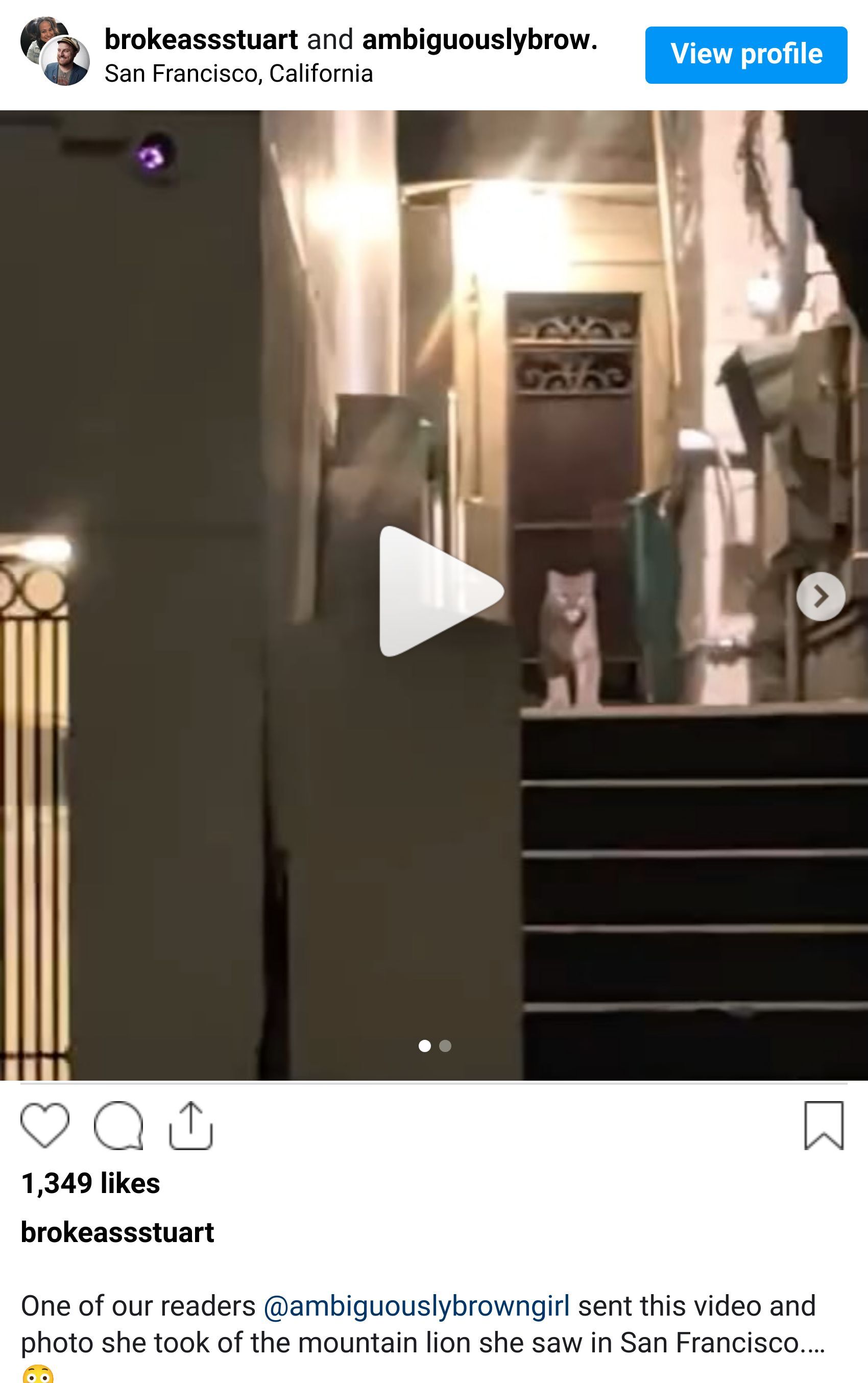
This isn’t the first time a mountain lion was spotted within SF city limits. The last confirmed sighting happened five years ago in Bernal Heights. That lion was released to its rural, natural habitat following its safe capture and veterinary examination at the Oakland Zoo. Experts via SF Animal Care & Control have tentatively identified the Lafayette Park cougar as a juvenile around a year old. (SF Chronicle) The young lion is most likely lost, separated from its pack, and overwhelmed by the urban environment.
“These animals often hide during the day,” SFAC&C spokesperson Angela Yip told the Chronicle. “There’s a good chance the animal has hunkered down in Lafayette Park.”

P-19, aka Selfie Cat, a mountain lion in the Santa Monica Mountains in Los Angeles County, California. Creative commons.
You know these cats can climb trees, right?
On Monday, SF Animal Care & Control, park rangers, and California Department of Fish & Wildlife officers converged on Lafayette Park. Rangers alerted the public to the mountain lion’s presence with warning signs and verbal cautionings at park entrances. People were reportedly unfazed by the news, with many visitors staying well into sunset, when mountain lions frequently hunt. Their habits are evolving too, necessarily in response to human infringement on cougar territory. A mountain lion is a swift, smart predator, but so far removed from its environment, it may behave erratically. Despite the warnings, parents and pet owners seemed perfectly content to play fetch with dogs and let kids run around.
“‘We would like you to stay out of the area but you don’t have to,’ a ranger told a woman pushing a child in a stroller, who continued past him into the park.” — Tara Duggan, SF Chronicle.
I’d like to think everyone reading this knows not to enter an area where mountain lions have been spotted. Especially if you walk in accompanied by easy meals, on two legs or four. A mountain lion lost in a city is pressed for food options. Imagine being so dumb, you’ll let your kid get eaten by a mountain lion in the middle of San Francisco. It’s not like you were in the Australian Outback, so you’d have no excuse, just a child-sized casket (definitely closed). Please, don’t be a dumbass.
If you encounter a mountain lion, first, do not run. Maintain eye contact with the animal, and stay put. If you run or turn your back, you risk activating the lion’s predatorial instinct to chase. Make yourself appear larger while growling, shouting, or yelling at it. The goal is to make the lion think you are dangerous—i.e. not prey. Once it realizes you aren’t prey, the animal should leave. Do not move until the cat is out of your sight, then leave calmly and quietly. If it feints an attack, you are probably in close proximity to its cubs without realizing it. Back away slowly and do not crouch, as you’d mimic the shape of its prey. Both you and the animal want you out of its territory ASAP.
Find more ways to avoid becoming a mountain lion’s dinner here.
Happy hiking, don’t die!

A mountain lion pawprint in sediment on the Santa Clara River. March 2019, Southern California. Creative commons.