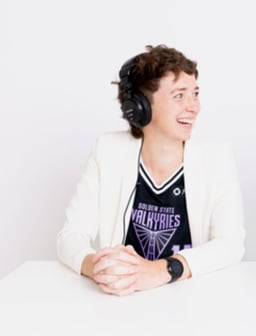

Photo by Scott Wall
You might have seen Doubt, the five-time Oscar-nominated movie starring Meryl Streep and Phillip Seymour Hoffman. Originally a Pulitzer Prize and Tony Award-winning stage play written by John Patrick Shanley, it’s a psychological thriller set in 1964 that captures a fierce battle of wills between a nun, Sister Aloysius, and a priest, Father Flannigan, inside a strict Catholic School.
Now, Opera Parallèle is delivering the West Coast premiere of Douglas J. Cuomo's operatic adaptation at the Presidio Theatre from May 29 to May 31.
This adaptation strips away traditional operatic conventions to create an intimate and immersive experience. Director Brian Staufenbiel has placed the 15-piece chamber orchestra directly on the stage, wrapping the audience around the performance area like a church congregation, alongside the characters.
Ahead of opening weekend, principal cast members Rhoslyn Jones (Sister Aloysius) and Matthew Worth (Father Flynn) talked with me over the phone about translating Shanley’s masterwork of suspicion into a visceral musical thriller.

Cast member Naomi Steele, composer Douglas Cuomo, cast member Matthew Worth, and cast member Rhoslyn Jones. Photo by Scott Wall.
Q&A with Rhoslyn Jones (Sister Aloysius)
Kellie: This iconic role was famously played by Meryl Streep on screen. How do you step out from under that performance to find your own identity for Sister Aloysius?
Rhoslyn Jones: It’s not easy. It’s a little bit like karaoke night—you never want to tackle a Whitney Houston, Celine Dion, or Mariah Carey song. Meryl Streep is the Whitney Houston of acting. Because those are such impossible shoes to fill, I don't try to copy her. Instead, I use her performance purely as information and inspiration.
Kellie: It can be easy for an audience to dislike her stern exterior immediately. How did you find her underlying humanity?
Jones: She is quite stern from the get-go and skeptical from the downbeat. But the text and music show very early on that past events have informed her directness. Her husband died in the war. In those times, there were very few professional options for a widowed, middle-aged woman besides turning to the church and teaching. She had limited choices, but she committed completely. She decided she was going to do it well, and do it the right way.
Kellie: From what I know, this production marks your debut with Opera Parallèle. Is that right? And how does their reputation—they’re a little bit boundary-pushing—how does that challenge you differently than traditional opera companies?
Jones: “Yes, this is my first time working with them, although I’ve lived in San Francisco for quite a while now and primarily worked with San Francisco Opera, a big grand opera house.
But I’ve always gone to a lot of Opera Parallèle’s performances. For me, diversity of art is what I love the most. The way that they present socially and politically interesting pieces, I think for me, it just makes all art better. What I’ve admired and quickly grown to see in person, firsthand, is that they really walk the walk of ‘this is how we do things.’
They may not have the budget of larger opera companies in this country, but it’s the quality of work that they do. I was just telling someone this morning that I think it’s one of my most favorite opera companies I’ve ever worked with because of that, because of the love they pour into this work and how passionate they are about what they do and their mission. I really think their work is important.
It’s also appealing to an entirely different audience than I’m used to. I think a lot of people who don’t know a lot about opera assume there’s a certain type of audience at the opera. And I think one of the magical things of Opera Parallèle is that they just kind of throw that entire stereotype out the window.”
”Kellie: How has the new chamber orchestra arrangement influenced your interpretation of the story?
Jones: “The music gives each character its own sonic world. You can identify when it’s my music. You can identify when it’s Father Flynn’s music because of the way it’s written.
The orchestra is much smaller this time, but they’re on stage with us. There are solo moments where members of the orchestra stand on stage and play thematic music with us. It really solidifies that connection between the music and the text. It makes the whole experience much more personalized and intimate and direct.”
Kellie: How would you say your vocals interact with the orchestra to bring out Aloysius’s tactical sort of way of thinking?
Jones: “The music is really hard from a musical perspective because she’s a difficult woman. The composer has been able to give incredible insight into why he wrote it the way he did.
When I was learning it, I was like, this is impossible. There’s no way I’m going to be able to sing this. Most of her music is identifiable through this angular, pointy sound. There’s this repeated motive that is Sister Aloysius’s music. It speaks to her directness, her giving absolutely no fucks.
Kellie: After having lived in Sister Aloysius’s shoes, has your relationship with certainty changed?
Jones: “Not until you just asked me (laughs). I’m a Taurus and I’m usually pretty sure of when I’m right (laughs). I’m pretty doubtful of everything I read and listen to these days Sometimes these terrible things do happen and sometimes they don’t.
We live in both of those worlds.”

Rhoslyn Jones and Matthew Worth in rehearsal. Photo by Scott Wall
Q&A with Matthew Worth (Father Flynn)
Kellie: In the original play, actors playing Father Flynn were instructed never to definitively reveal whether the character is guilty. In this adaptation, how do you approach your character under that condition? Do you decide on his guilt for yourself?
Matthew Worth: “Honestly, I like going back and forth in the rehearsal room and trying out every day for myself. ‘Okay, so what if this is a case of Father Flynn having a secret in his past? Maybe he's a gay man and he doesn't want anybody to know about that. Or what if he actually is the predator of all of these children? Or what if he's perfectly innocent through all of this and really just wants to lift up the church and has a true connection with each of the students?’”
Kellie: How does playing with that ambiguity day-to-day change how you interact with a live audience?
Worth: “It changes the show completely because I am constantly reading and feeling how the room reacts to certain lines. Depending on the energy the audience gives off, I will intentionally infuse either a sense of pure benevolence or subtle malevolence directly into my lines.”
Kellie: What does adding a contemporary operatic score do to the raw, psychological tension of the script?
Worth: “I think Doug's score really heightens every emotion, and it allows for the undercurrent of thought to have a sonic world brought to the audience. I really appreciate that.
There's this moment in my duet with Sister James where I ask her, “Who put this idea into your head?” And she's like, “Well, I wish it never entered my mind.” And there's this tumultuous thinking music that Doug puts in there.
In the original stage version, you would see it in the actor's eyes. But in this operatic realm, you'll see it in the actor's eyes and hear it in the sonic world that the orchestra presents in between the lines themselves. So I think there's a heightening of the inner feelings of each of the four major characters.”
Kellie: I understand you and Rhoslyn have a friendly relationship and you both work at the conservatory together. In this opera your characters are in a high-stakes psychological war. How do you build that intense onstage animosity when you're actually friends and colleagues in real life?
A: Lots of hugs off the stage.
To be honest, when one delivers the lines from a place of true believing, the animosity will come naturally. The confrontations will come naturally. If we don’t overload them or undersell them, but deliver them as they are, the emotions then will be palpable for the audience. That's just how it goes.
And then in the wake of every scene that we've rehearsed, go and grab a coffee with my friend and shoot the shit a little bit. It's great to just be Roz's friend and colleague. She's a top-notch person and artist.
So it's one of those things where we can go and do the thing on stage and then immediately go back to the love we have for each other.
Kellie: In this production there are no other real characters on stage except the central characters, right? What is that like for you, especially in this production?
Worth: Yeah. I think that's a convention that over the course of my career I've grown accustomed to.
Oftentimes we have to create the story that exists between the story. One of the great conversations we've had with Brian, our amazing director, is talking about what has happened in between these two scenes. You've been living in this enclosed space probably within one block in New York, and you've seen each other. Has she come to confession? No, she hasn't come to confession. We know she's been skipping that, so she's been avoiding you.
What I've learned from Father Flynn playing this character is that's kind of a fun thing to do with all of the characters we play. We seem to think that Don Giovanni is one thing or Figaro is one thing or Romeo is one thing, but we get to create a lot of what's been going on for these characters ourselves in between the scenes and before the scenes and after the scenes. I really love that and how it can inform what we bring to the stage each performance.
Filling in the backstory of it all has always been a really interesting part of this career, and I love that part of being somewhat of a scriptwriter ourselves.
Kellie: That's a really interesting approach! I never thought about it that way.
Worth: I'll relay this wonderful anecdotal story. When we were premiering the piece, we were doing a table read with John Shanley there, and Denise Graves — who's a bigwig in our operatic world and has been for decades — was singing the role of Mrs. Miller.
When Denise was talking about the character, she said, “I think it's pretty straightforward that this is a woman who is afraid of her husband, who beats her son, and that she just has her son's best interest at heart.”
And Shanley goes, “Yeah, well, what if she's lying?”
This is the man who wrote the play. And he's like, “What if she's lying about her husband beating her son?” I never would have considered that a character we are portraying on stage would be lying about what they're saying. But of course, we lie all the time in real life. Who's to say that every word we say in these plays, musicals, or operas is the truth?
Kellie: I saw somewhere that you mentioned your generation of performers needs to get off their high horse about opera and go into the community and cultivate audiences. What does that look like for you in practice?
Worth: I think if we focus on the art form and do that to the best of our ability — whether that's being an old-school singer and making expressive sounds or telling expressive stories — that's our greatest charge.
Tell the stories.
In this age of artificial intelligence and what's going on in the arts, are we generating all of these sonic worlds that are either augmented by artificial intelligence or solely created by artificial intelligence?
I think one of our great charges as artists is to return to the campfire and tell the stories with human voices in human spaces.
I think we're getting to this place right now where people are starting to return to the operatic realm in particular, for these stories told by humans for humans. I love that about our art form right now.

Creative director Brian Staufenbiel, composer Douglas Cuomo, and conductor Nicole Paiement; Photo by Scott Wall
Don’t miss Opera Parallèle’s Doubt this weekend!
When: Friday, May 29 and Saturday May 30, 2026 at 7:30 pm and Sunday, May 31, 2026 at 3:00 pm.
Where: Presidio Theatre (99 Moraga Ave, San Francisco)
Pre-Show QA: Arrive 60 minutes early (6:30 PM on Saturday) for a free pre-show conversation with the director, composer, and conductor.
Tickets: Available directly via the Presidio Theatre Box Office.