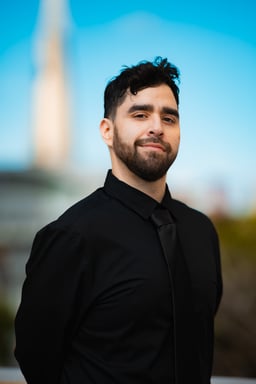
Black List founder Franklin Leonard in conversation with Bay Area writer/producer/actor Rafael Casal. Photo from The Bay List
by A. Austin
"There's a lot of originality in screenwriting right now. I think there's less originality in what gets financed," said Franklin Leonard, film producer and founder of the Black List, during a 2024 Salon for Bay Area screenwriters.
Many screenwriters face job insecurity and struggle to sell their original scripts. The Writers Guild of America (WGA) reported in 2025 that jobs for writers in television and movies have steadily declined over the past couple of years.
The Black List was founded in 2005 by Franklin Leonard to address issues of inaccessibility. The Black List has two components– it is an internet platform for writers to "showcase their projects for industry professionals and get high-quality evaluations from vetted readers," and it is an annual survey which asks "hundreds of Hollywood film industry executives about their favorite unproduced screenplays from that calendar year."
According to their website page about the annual survey, "at least 440 Black List scripts have been produced, grossing over $30 billion in box office worldwide. Black List movies have won 54 Academy Awards from 267 nominations, including four of the last twelve Best Picture Oscars and eleven of the last 28 Best Screenplay Oscars."
The platform and survey have had a profound impact on screenwriting in Hollywood.
One night, Bay Area native and co-writer/producer of the 2018 film "Blindspotting" Rafael Casal messaged Leonard with an idea– to make a survey like the Black List, but for scripts specifically from the Bay Area. Plans for a regional survey began to develop, though they were first used to make the Georgia List and serve Leonard's home state.
When it came time to focus on the Bay List, Casal brought on his producing partner and childhood friend, Sam Bempong. The two met in middle school and worked together on low budget films throughout their teens.
"It often involved everyone who could muster up 20 dollars putting it on a table so we could rent a camera," Bempong recounted. As time went on, "the calls kept coming and the budgets got bigger."

The 2025 films from The Bay List
On the mission of the Bay List, Bempong said "We took our cue from Franklin (Leonard) who really democratized the process. And we just want to make sure that… if you have a story to tell, it's not about who you know…. Let's help people who might not have had that access."
But accessibility does not begin and end with a competition. The Bay List creators had to ensure that the infrastructure existed to support winners and their potential productions, something the Bay Area has historically struggled with.
"When (Rafael Casal and Daveed Diggs) did 'Blindspotting,' the television show, and Boots Riley did 'I'm a Virgo,' both wanted to film 100% in the Bay Area. Combined they would have spent over 100 million dollars in the local community," Bempong explained. "That's hiring artists, a dry cleaning contract, catering, truck drivers, the whole (nine yards). But the Bay was not really set up to receive productions of that size, and so they had to go elsewhere... So in the wake of that, it really started these conversations of 'How do we make our art at home? How do we make sure that the productions that want to be here can be here, and that folks who are coming up have opportunities?'"
They started the nonprofit initiative Make it Bay, powered by the East Bay Film Collective, which, along with other notable sponsors, advocated for and created financial incentives to attract film and television productions to Oakland.
"We're still fighting for a lot of those changes," Bempong said.
With this support in place, they got to work on the contest. Submissions opened in October of 2024 and closed in April of 2025. They had over one thousand screenplay and pilot episode submissions.
A short list which represented "different kinds of voices" from the Bay was pulled together, anonymized and passed on to the partners, said Kate Hagen, senior vice president of the Black List. From there, each partner evaluated the scripts by their own methods, and returned with ten scripts that they loved. They debated and discussed each script together.
The list was not based solely on popularity, though. If a script was truly loved by a couple partners, that could guarantee it a spot in the limelight.
"We could have had ten scripts that everyone agreed on but no one was passionate about… We wanted to make sure that whoever was on the inaugural Bay List actually gets benefit from it… So if we had a partner that was very excited for a specific script and ready to go to bat for that, it was very important that that script stayed," Bempong elaborated.

Tosin Coker
One such script was "FEMI," written by Tosin Coker. Its logline goes: "In a community plagued with violent cult activity, a young man struggling with personal and social adversity overcomes all odds stacked against him with the help of his supportive mother and his first love."
The feature length screenplay follows the semi-autobiographical story of Coker's teenage years in Lagos, Nigeria.
"I was the kid that was always getting in trouble… the gangs were all incentivised to recruit me," Coker said.
Born in the Bay Area to Nigerian parents, his family moved to Lagos when he was very young, then returning to Richmond, California at the age of 15. He attended the Academy of Art University for motion picture directing. His feature directorial debut, "Lara and the Beat," was released in 2018.
"I realized that there was a lot of emphasis on screenplays… so I took time off of directing, and I spent the next seven years building my craft in screenwriting. I didn't have any formal teachers… so I just took whatever I could get on the internet and I started writing. One forum that really did offer feedback and mentorship in a way was the Black List. The feedback I got helped me to keep on honing my craft…"
After making the Bay List, he has received "international co-production interest." His vision is to shoot FEMI wholly in Nigeria with a Bay Area crew, who can mentor up and coming Nigerian talent. He calls this world-spanning method "local for global."
Sean Nichols Lynch, Bay List winner and writer of "Whiskey Bent and Hell Bound," also attended film school in the Bay Area. The San Francisco State alum has written and directed multiple "micro-budget horror movies" with the connections he made during his time in the city.

Sean Nichols Lynch
The logline for his script is: "An alcoholic bounty hunter is hired by a Texas crime syndicate to hunt down a missing drug dealer, only to find himself caught up in a deadly kidnapping plot."
"I wrote the movie that I wanted to see," Lynch said, as he's a fan of "taught thrillers… (which) are genre but are also touching on social issues." He was inspired by "No Country for Old Men" (2007) and "Hell or High Water" (2016).
"I'm very excited about it," Lynch said of the competition win. "I've gotten to meet some of the other contest winners, who are super talented and I'm just honored to be part of this group."
Lynch also met Rafael Casal, whom he said was "very passionate about bringing exposure to writers from the Bay Area, which is sort of an overlooked community. It tends to all be either L.A. or New York, and I think that's kind of what motivated him to start all of this, which has been amazing… Just to get more exposure for more Bay Area writers."
For Lynch, like many writers, the opportunity couldn't come soon enough. "Especially having been at this for so long, and having so few lucky breaks, I kind of need to make it for myself, to be motivated… And just to blindly submit something and have it be in the company of all these other great writers is such a moral booster. It's a sign that if you write good scripts, sometimes that's all you need… that's (what's) really exciting about the Bay List."
So, will there be another Bay List? Sam Bempong says there will, and that all of the partners– which include production companies Lucasfilm and Playtone– have signed on to participate in the next competition. While the timeline is still being worked out, she says the Bay List will likely be biennial.
"We're creating an ongoing pool of vetted writers from the Bay, so we will continue to add to that and we will continue to make sure that the world notices the stories coming from the Bay," Bempong said.