
Black women stare out from the walls of MAG Gallery in San Francisco. Rendered in black and white, the faces and poses, along with the tonal quality, reference tintypes and dry plate photography of the late nineteenth century. The subjects sit as regal as the arcana in a tarot deck, surrounded by objects of art, science, and knowledge. In front of these large-scale images, small altars sit with objects from the images behind them, seemingly pulled from the photographs into reality. Equal parts imagination and hope, this is AfroFuture Past, a series by artist Rhiannon Evans MacFadyen.

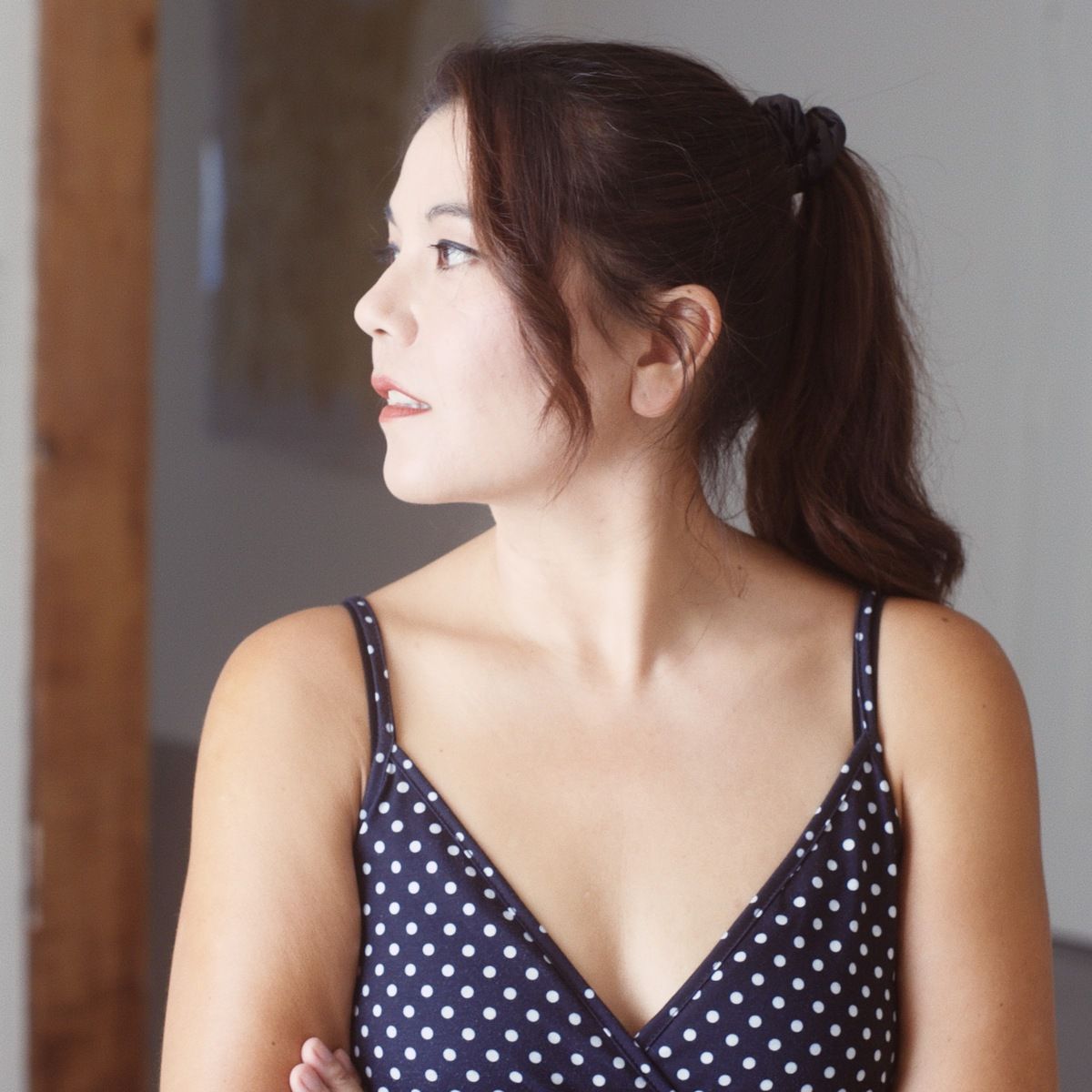
Rhiannon Evans MacFadyen at her exhibition “AfroFuture Past” on now through February 1, 2026 at MAG Galleries in San Francisco. Photo by Vita Hewitt.
The works explore imagined histories of American Black women. None of the women in the images exists or has ever existed. These are the ancestors MacFadyen dreams might have lived had slavery not occurred. They are strong Black women who live outside the trauma and history of child slavery. “This is AfroFuture Past because this is going back to the history that would have built that future,” MacFadyen explains. “So it’s not present, but it’s merging this futuristic idea and going back in time and thinking about the Black women that would have already been here. Because there were folks that were already here before Columbus, there were folks that came, and there were a couple of folks that managed to flee and were never found again. They established their own life. So what would these lives be like?”
MacFadyen enacts these ideas through a blend of new and old technologies, integrating them with ancestral mediums and methodologies. The altars are built of handmade objects and antique specimens, while the portraits utilize both artificial intelligence and Photoshop in their creation.

An altar of objects made from imagined ancestors in MacFayden’s world building. Photo by Vita Hewitt.
“Among the many digital and analog tools I use for this project, Artificial Intelligence is a central medium,” MacFadyen says. “It allows me to conjure ancestors who might have been, without calling in the spirit of anyone already existing. To use it, I’ve had to navigate technology bias, racism, representation, and questions about the role of new technologies in the visual arts. I also take the objects and mementos rendered and make them tangible through sculpture and altar building, leaning into the liminal space between fact and storytelling in both history and technology.” She adds, “The histories go all the way back to the late seventeen hundreds, and then come all the way up through what feels like the nineteen forties. I’m imagining a community where science, herbalism, magic, art, and community care are all one thing.”

Detail from a printed tapestry from “AfroFuture Past”. Photo by Vita Hewitt.
An accomplished photographer, MacFadyen made a conscious decision not to photograph her contemporaries while world-building. “I photographed people for ages, but it’s different when you’re taking a picture of somebody and something feels contemporary, or you’re using their image for something,” she says. Using AI allowed her to imagine people who do not exist, transforming them into elders, aunties, and community members without exploiting real individuals. “That respect became important,” she notes.

Antiques and handmade sculpture make up the altars at “AfroFuture Past”. Photo by Vita Hewitt.
The conversation between the portraits and their accompanying objects forms the emotional core of the exhibition. MacFadyen’s belief in these imagined ancestors feels complete enough that viewers can almost see a shared lineage of knowledge passed down across centuries. It is a vision of a world free from ancestral trauma, where Black women flourish in sunlight rather than survive in shadow. The effect is quietly radical, a reminder that such worlds were possible and still are.
“All of the women in this room would respond the way any auntie or elder would,” MacFadyen says. “They’re looking at us to make the world they’re living in, a world where dignity, science, art, and community exist together. They were able to do it, and they’re looking at us to do that now.”
AfroFuture Past is on view at MAG Gallery, 3931 18th Street in San Francisco, through February 1, 2026.
Upcoming events
January 17, Working with Ancestors, a panel discussion with Afatashi the Artist, Demetri Broxton, and Rhiannon Evans MacFadyen, from 3 to 4 pm. Part of SF Art Week’s official programming.
February 1, closing reception, from 3 to 5 pm.