
Renée Leann Castro-Ring (LisjanbandoftheOhloneTribe), Rinihmu Pulte’irekne, 2025. Mixed media triptych: wood, metal leaf, acrylic, pine nut beads,olivelle shells. Courtesy of Renée Leann Castro-Ring (LisjanbandoftheOhloneTribe).
For many people living in California, the idea of a wildfire ripping through the town you live in is not such an outlandish thought. We’ve almost come to accept this fact, grumbling to one another about climate change and worrying about home insurance being dropped.
What if there was another option, and one that has been a practice for a millennia? Good Fire: Tending Native Lands, now on view at the Oakland Museum of California, explores how Native communities in California have utilized controlled fire to care for the land, keep communities safe, and encourage the growth of native plants.

Maddy Rifka, Hoopa Valley Tribal member. Steven Saiz watches flames snake through thick underbrush during a cultural burn managed by the Cultural Fire Management Council. Courtesy of Maddy Rifka
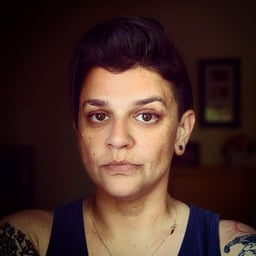
Recently, Native Californians have been advocating for the right to manage controlled burns. On my visit to the museum, I was joined by Renée Leann Castro, a Lisjan Ohlone artist whose triptych painting is included in the show. “I hope what people get from this exhibition is to see what it means to work with fire. Fire isn’t bad, I know that in California, it’s scary for people because we have so many wildfires. But I think people need to understand the reason why we have so many wildfires is because the people that took over didn’t maintain the land,” she says.

Installation view, Good Fire: Tending Native Lands, November 7, 2025–May 31, 2026, Oakland Museum of California. Photo by Kiki King, courtesy Oakland Museum of California
Good Fire delves deep into how fire can revitalize ecosystems, encouraging growth in plants used for food, basketry, and medicine. Separated into three parts, we see how fire is used with different Native tribes, the future of fire, and then fire interrupted. Natural torches of tule (which we learn grows straighter and stronger after a fire), wormwood, and manzanita sit peacefully in vitrines. Baskets, paintings, collages, and an extraordinary piece by Tisina Ta-Till-ium Parker, as well as interactive videos on the history of controlled burns, are included in the show.

Tiśina Tatillium Parker (Southern Sierra Miwuk, Kucadikadi Mono Lake Paiute, Kashia Pomo), Chi/LOW/pa’:,2025. Women’s regalia with top knot. Installation view, GoodFire: Tending Native Lands, November 7, 2025, May 31, 2026, Oakland Museum of California. PhotobyKiki King, courtesy Oakland Museum of California
Castro’s work is found in the room focused on the future of fire. “Cultural burns are so important because it allows us to continue with our own ceremonies, to continue on with tradition. Without fire, things like tule or sourberry, can’t grow right. That means an ancestor, your auntie, can’t make her basket. And we have to rely on other sources of materials, which we would prefer to use our own, the stuff that’s grown on our own land,” Castro says.
She wears many hats in the art world and in her community. A year-long intern at the Fine Arts Museums of San Francisco, which encompasses both the de Young and the Legion of Honor. Castro works restoring artworks ranging from Indigenous cultural material to Greek and Roman sculpture as well as creating new works her own art practice which covers a wide range or mediums and materials.

Renee Leann Castro at a Tule harvest for Alliance for Felix Cove in September 2025. Photo by Vita Hewitt.
Interview: Renée Leann Castro
BAS: What is the conceptual basis of your art?
RC: The conceptual basis of my artwork centers on Indigenous presence, memory, and the ways cultural knowledge persists despite erasure. I’m interested in how natural materials hold stories and how art making can repair broken or interrupted connections between people, land, and history. Much of my artwork asks what it means to reclaim visibility in places where Indigenous communities were long overlooked, and how art can help repair that relationship.
BAS: What kinds of mediums do you work in?
RC: I work across a wide range of mediums, including intaglio printmaking, gouache, acrylic painting, digital painting, and underglaze on ceramics. I also build my own surfaces, cutting wood panels and plexiglass on the bandsaw, carving script into it with a Dremel, and using heat to shape plexi into sculptural forms. My practice often incorporates embroidery, sewing, beading, and gold leaf, allowing me to move fluidly between two-dimensional and tactile, material-driven work.
BAS:Your work leans into community and culture. Where would you like it to be shown, and what do you want people to take away after seeing it?
RC: I want my work to be shown in spaces that welcome dialogue between Indigenous and non-Indigenous audiences, museums, community centers, cultural institutions, universities, and places where people gather to learn about the land they’re on and the Indigenous people that were there before them, and in most cases, still there. For my own community, I hope the work feels like recognition and a reminder that our stories, aesthetics, and relationships to place are alive and continuing. For people outside my community, I want them to understand that Ohlone presence is not historical, but ongoing.

Waabanishmo by Renee Leann Castro.
Good Fire: Tending Native lands is on at OMCA through May 31, 2026
For more on Renee's upcoming exhibitions:
The Land You Stand On at the Lyman Allyn
Art Museum in New London, Connecticut will be on September 25, 2026
through January 22, 2027.