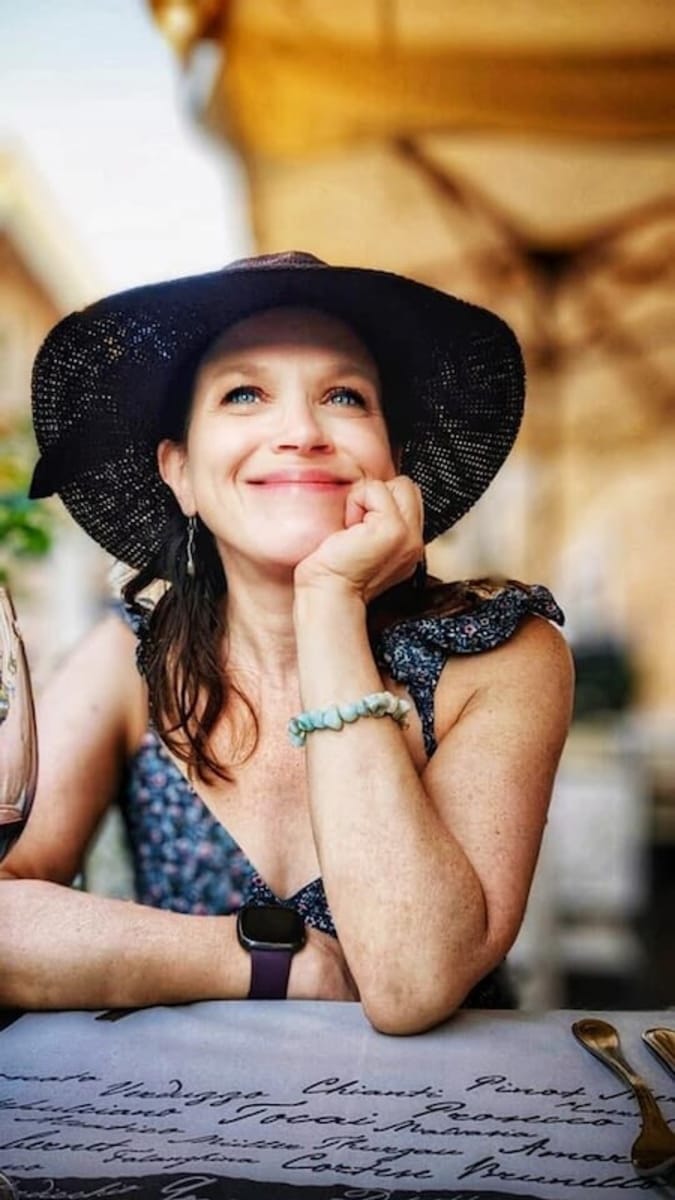

Maestra Jessica Bejarano. Photo credit: Howard Lui
When Maestra Jessica Bejarano steps onto the podium, she commands attention, conducting with precision, intensity, and unmistakable joy, drawing sound from the orchestra in a way that feels immersive. Her connection to the music, her orchestra, and the audience is palpable.
For Bejarano, conducting isn’t simply about technical precision or “waving a stick.” It’s about helping musicians understand the humanity inside the music, the emotional story behind why a composer wrote what they wrote.
“Music is intimate,” she says. “It should be joyful.”
One musician recently told her after a soundcheck, “You just have the biggest smile on your face when you conduct. It’s amazing to see the joy on your face.”
“My smile gave her a smile,” Bejarano says.
Bejarano is a rare, boundary-breaking force in a classical world where fewer than 21% of conductors are women, and her story is as compelling as her presence.
Growing up in East Los Angeles in a largely minority, low-income neighborhood, Bejarano was raised by a single mother from Tijuana who worked multiple jobs and scavenged through garbage to collect aluminum cans to make ends meet.
Her high school, Bell Gardens High, was known for grim statistics. “It was notorious for high teenage pregnancy, high dropout rates, high incarceration rates, and high murder rates. And I was part of none of those statistics. Music saved my life because it took me out of East LA,” Bejarano says.
Music entered her life accidentally. Around age 10, she picked up her brother’s trumpet and secretly taught herself to play and read music. It was a turning point. Soon she found herself in the school band as trumpet section leader, eventually conducting sectionals.

Catch the Season Finale of the SF Philharmonic, May 30th.
Photo Credit: Howard Liu
As the drum major in high school, she was conducting in the stands during football games, eventually leading the band. “Our music directors were always quitting, so I was always asked to lead the class,” she says. “When we finally got a music director who stayed, she let me continue leading.”
Bejarano’s family was encouraging but surprised about her newfound musical talents. “They were like, ‘Where did you come from?’” She laughed.
At Pasadena City College, where she originally planned to become a music teacher, a friend convinced her to join the orchestra.
“I was like, ‘Orchestra? What’s that?’ I’d never heard an orchestra before. Classical music just wasn’t part of my world growing up. It just wasn’t there.”
The first rehearsal blew her mind. “I was looking around at all the instruments, thinking, what is this? I’d never seen anything like it. We rehearsed Beethoven’s Symphony No. 5, and I was like, ‘What is this music and why have I never heard it before?’ I felt it in my body—it was an instant spark. The music was always in me, but it felt like it had been activated, and after that, I wanted to know everything I could about classical music. I wanted to immerse myself in it.”
Obsessed, she went straight to Tower Records, bought stacks of classical CDs, and spent the night listening and crying. “I was thinking, ‘This is beautiful music. Why has this been absent from my life for the last 18 years?’ And then I realized, ‘I have it now, and I’m not letting it go.’”

Troopers Drum and Bugle Corps.
Photo By MikeGough - commons.wikimedia.org
It was around that time that a friend encouraged Bejarano to try out for the Troopers Drum and Bugle Corps, a World Class competitive junior corps based at Casper College in Casper, Wyoming. “I auditioned, won the audition, and rejected it, deciding to go back to Los Angeles,” out of fear, she reveals. Casper, Wyoming, felt completely alien compared to East LA, and her immediate instinct was to retreat to the safety of what she knew, choosing to turn down the opportunity.
But a chance encounter with Ron Jones, composer of Star Trek: The Next Generation, DuckTales, American Dad!, and Family Guy, changed everything.
“He told me I needed to keep playing music, and offered to pay for everything—the flight to Wyoming, tuition, housing—everything, if I would take a position with the Troopers. He became my mentor,” she tells me.
Bejarano found Wyoming to be just what she needed: a beautiful, serene, and quiet place to focus on her music. She attended Casper College on a trumpet music scholarship, and after completing her Associate of Fine Arts in Music Education there, she transferred to the University of Wyoming on a full scholarship where she was a drum major and pep band director, to finish her bachelor’s degree.
And that’s where she had another revelation.
“I had to take a course in basic conducting, and I asked my professor to give me private lessons. Once a week, I would go to his office, and he taught me how to score study, baton technique, and rehearsal techniques. That’s when I fell in love with conducting, and that’s when it hit me. I was like, Oh, my God! I’m going to be a conductor!”

Photo credit: Howard Lui
Bejarano didn’t yet understand how inhospitable that path could be. But she would soon find out.
While in graduate school at UC Davis, Bejarano encountered a professor who seemed determined to crush her dream. He publicly demeaned her while she conducted in front of the orchestra, warning, “I’m watching you. Make one mistake, and you’re out of here,” while also making discriminatory comments during private lessons.
“One time, he stopped a lesson and asked me if I was serious. I didn’t understand, so I asked him what he meant. He pointed at me, up and down, and said, ‘Are you serious?’ And I said, about conducting? Yes, I’m serious! I’m very serious. I’m passionate about becoming a conductor. And he goes, ‘Well, then go back to your country, because it’s not going to happen in mine.’ I said, What? This is my country! I was born in San Diego. Do you want to see my birth certificate?”
She left school early that day, shocked, and briefly considered quitting altogether. Instead, she quickly turned the cruelty into fuel. “That experience made me even more passionate about becoming a conductor.”
Misogyny followed elsewhere. At a European conducting workshop, she witnessed a maestro advise a female conductor to rely on her beauty rather than her skill.
Conducting, she says, often forces women into impossible contradictions.
“When men walk onto the podium with strength and bravado, they’re seen as leaders,” she says. “When a woman walks out with that same energy, she’s a bitch. But if she comes out quieter or softer, then people say she’s not strong enough to lead a 75-piece orchestra.”
“Sometimes,” Bejarano says, “you just have to have your eyes and ears wide open and grow from these experiences.”
And she did exactly that.

Photo credit: Howard Liu
After earning her master’s degree in orchestral conducting from UC Davis, Bejarano began assembling the career she had fought so hard to claim. She studied and conducted internationally, including work in Italy, Russia, and Romania, while taking on teaching and artistic leadership roles. She mentored young musicians, directed youth ensembles, and steadily built credibility in a field that rarely welcomes women—particularly women of color—onto the podium. The dream she refused to surrender in the face of adversity was gaining traction.
Then came the loss that brought her to her knees.
On Mother’s Day in 2012, Bejarano’s mother suffered a massive brain aneurysm and fell into a coma. Bejarano played Beethoven’s Piano Concerto No. 5—the Adagio she listened to every day at the time—into her mother’s ear, hoping the music that had saved her life might somehow save her mother’s.
But it didn’t.
Bejarano’s mother passed away two hours later.
“After she passed away, I hated music. I thought, ‘Screw you, music! How dare you! Why did you let her go?’ I couldn’t do music anymore.”
She quit teaching, conducting, and performing, retreating into depression for a year. In search of a different future, she pursued her second passion: becoming a police officer. She applied for the San Francisco Police Department and made it all the way to the final stage, but she ran into the one obstacle she couldn’t overcome: a six-foot wall she couldn’t climb.
“I tried three times, but I couldn’t do it. The police department told me to try again in six months, and if I could climb the wall, I’d be in.”
But fate had other plans.
Needing money, Bejarano began teaching piano lessons again. One student changed everything.
“I was teaching piano lessons to this 5-year-old little girl, Georgia Brown,” she says. “One day, while we were waiting for her parents to pick her up, she said, ‘I’m gonna draw you a superhero.’”
The little girl drew a ballerina. Bejarano asked if ballerinas were her superheroes.
“And she said, ‘No, you’re my superhero because you make music and you make ballerinas dance.’”
Bejarano broke down.
“In that moment, I cried. And I thought, what am I doing trying to become a police officer? I need to get back into music!”

Photo credit: Howard Liu
Bejarano’s return to music came with a sharpened sense of purpose.
After years of sexism, racism, gatekeeping, and watching talented women pushed out of conducting within the world of classical music, she wanted to build something different.
The idea came to her on a flight home from Bulgaria, where she had been working as an assistant conductor at an opera house.
“I decided to create my own orchestra where it’s okay to be a female conductor, where it’s okay to look like me, where diversity isn’t just part of a mission statement, but an actual living, breathing thing.”
Bejarano called on her closest friends, each bringing different strengths in the arts, development, and design.
“We built it within a month.”
The San Francisco Philharmonic came together in August 2019. By November, it had secured official 501(c)(3) nonprofit status. Its first rehearsal took place in January 2020, followed by its inaugural performance the next month.
With no institutional backing and little credibility as a brand-new organization, Bejarano funded the San Francisco Philharmonic’s first concert herself, draining her savings to make it happen.
“I used all of my savings,” she says. “It was the best use of my money.”
It was also a profound act of belief in herself and her mission.
Today, the 85-member San Francisco Philharmonic reflects the vision Bejarano imagined from the start: a place where excellence and inclusion coexist.
“For the first 18 years of my life, I didn’t have this,” she says. “It was thought that it was for certain people. I want to make sure that it’s for everyone.”
Rather than waiting for diverse audiences to walk through the doors, Bejarano actively invites them in—partnering with schools, drag performers, the Mexican Consulate, LGBTQ+ organizations like Lipstick Lesbians, and other community groups to make sure the concert hall reflects the broader community.
“One of the things audience members consistently tell me is that they feel welcomed and at home at our concerts,” she says. “When they look around and see the diversity of people, they feel like they belong there.”
“I want this to feel like a safe place,” she says. “A place where everyone can enjoy high-caliber music.”
For the woman who discovered Beethoven at 18 and wondered why this world had been kept from her, opening that world to others may be the most meaningful act of all.
The San Francisco Philharmonic’s final show of the season is right around the corner:

SF Philharmonic and Anne Richardson
Catch Maestra Jessica Bejarano and the San Francisco Philharmonic with acclaimed cellist Anne Richardson for an evening of sweeping emotion:
Marche Slav — Tchaikovsky
Variations on a Rococo Theme, Op. 33, Anne Richardson, soloist — Tchaikovsky
Enigma Variations — Elgar
Herbst Theatre
Saturday, May 30
7:30 PM
Get tickets for just $30 here